Black Spot, Mustard and Green Algae on Arizona Plaster: How to Tell Them Apart
Three kinds of algae, three different habits, and one reason the stubborn ones keep coming back.
October 19, 2026 · 3 min read
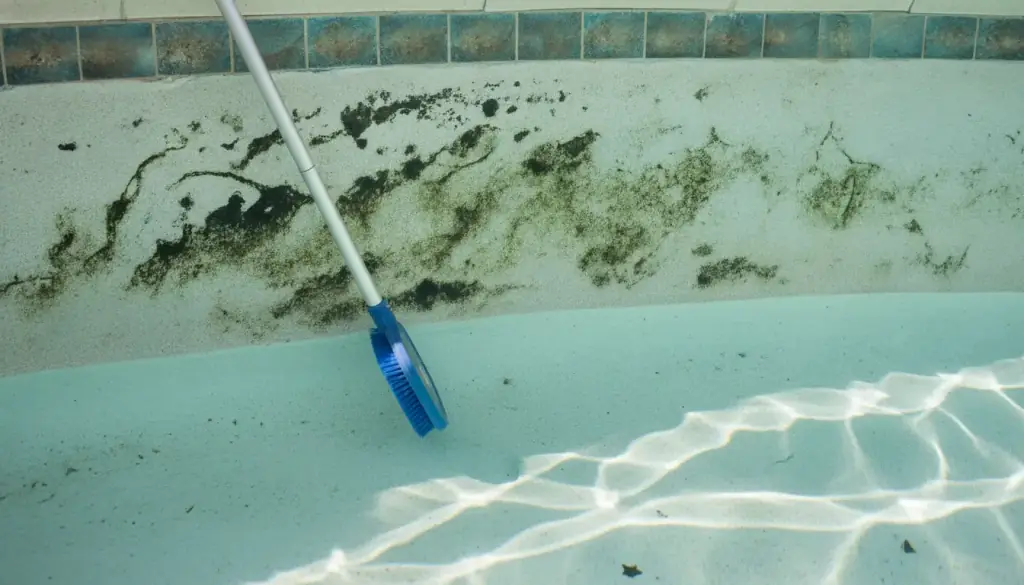
Most pool owners call it all algae and treat it the same way. That's understandable, and it's also why the same patch keeps returning. The three kinds you'll meet on Arizona plaster, green, mustard and black, behave differently, hide in different places, and come back for different reasons. Telling them apart is half the fix.
Green algae: the one everyone knows
Green algae is the easiest to recognize. The water turns hazy or fully green, and surfaces feel slippery. It can float in the water or coat the walls, and it grows fast in warm, sunny conditions, which describes an East Valley summer exactly. It's also the easiest type to clear, because it lives mostly in the water and on the surface, where sanitizer and a brush can reach it. If your whole pool has changed color, you likely have green. For the full-pool version of this problem, our green pool turn arounds are the usual answer.
Mustard algae: the yellow dust that returns
Mustard algae, sometimes called yellow algae, looks like a dusting of yellow-brown powder or pollen on the wall. It favors shady spots, like the side of the pool that stays out of the afternoon sun, behind ladders, or along a north-facing wall. It brushes off easily, and that's the trap. You brush it away, it looks gone, and a week later it's back.
It returns because mustard algae tends to resist ordinary sanitizer levels, and it doesn't stay only in the pool. It can live on swimsuits, pool toys, floats and brushes, then restart the colony the next time they touch the water. Anything that goes in the pool during an outbreak should be treated or washed. If it isn't, you reinfect your own pool.
Black algae: the one that roots into the plaster
Black algae shows up as dark blue-green to black spots, often round and raised, stuck to the plaster, grout lines and rough patches. It's the hardest of the three, and it's the one that makes owners think the plaster is damaged. The spots aren't stains. They're colonies with roots that work into the tiny pores of the surface, and a protective outer layer that shrugs off normal sanitizer.
Arizona plaster makes this worse. Hard water leaves mineral scale on the surface, scale makes plaster rougher, and rough plaster gives black algae more places to grab. You can brush the top of a spot and treat the water, and the roots stay behind to grow back from the same place.
A quick way to sort them
- Water gone green or cloudy, walls slippery: green algae
- Yellow-brown dust that brushes off and reappears in shade: mustard algae
- Dark spots stuck to plaster that don't brush off easily: black algae
Why they keep coming back
The reasons overlap, and they're mostly about the conditions, not the treatment. Weak circulation is the biggest one. Steps, corners, the area behind a ladder and the spot below a return can all be dead zones where water barely moves. Algae picks those first.
Skipped brushing is next. A film that would come off in seconds when it's young gets harder to remove every week. After that, there's load. Palo verde litter and monsoon dust feed algae, so a pool under trees or near open desert is always under pressure. And as noted, anything carried from one outbreak to the next, like toys and swimsuits, keeps the cycle alive.
Finally, the filter. A dirty or undersized filter can't remove the spores that float through every day. If the filter is tired, no amount of brushing keeps up.
What a real treatment looks like
A lasting fix goes after the cause as well as the color. In general terms: identify which algae it is, brush hard and often (black algae calls for a stiff brush on the spots), correct the water balance, raise sanitizer for a treatment period, and run and clean the filter through the whole cycle. Algaecides and water conditioners can help as part of that, but they're a support, never a substitute for brushing and circulation.
Del Sol Pool Service & Repair treats algae for homes and businesses across Chandler, Gilbert, Mesa, Tempe and Phoenix. We're family owned and operated, fully licensed, bonded and insured, ROC#275375. See algae treatments for what we do, then send the office a note or call (480) 272-7260, Monday through Friday, 8am to 5pm.
Del Sol Pool Service & Repair, (480) 272-7260
Call (480) 272-7260More articles
What a Weekly Pool Service Visit Actually Covers
Nine items, one visit a week, and a written record left on every visit.
Why East Valley Pools Turn Green in Summer, and What a Turn Around Involves
A pool can go from clear to green in the span of a long weekend, and it usually has a short list of causes.